How to Keep Your Knees Healthy: A Practical Guide

Quick answer
The most effective ways to keep your knees healthy are to stay regularly active, keep the thigh and hip muscles strong, maintain a healthy body weight, increase new activity gradually, and take joint injuries seriously so they heal properly. There is no supplement or gadget that protects knees the way these habits do. This guide from VinayakM in Greater Kailash-1 sets out what actually works and what to skip.
Last reviewed:
July 5, 2026
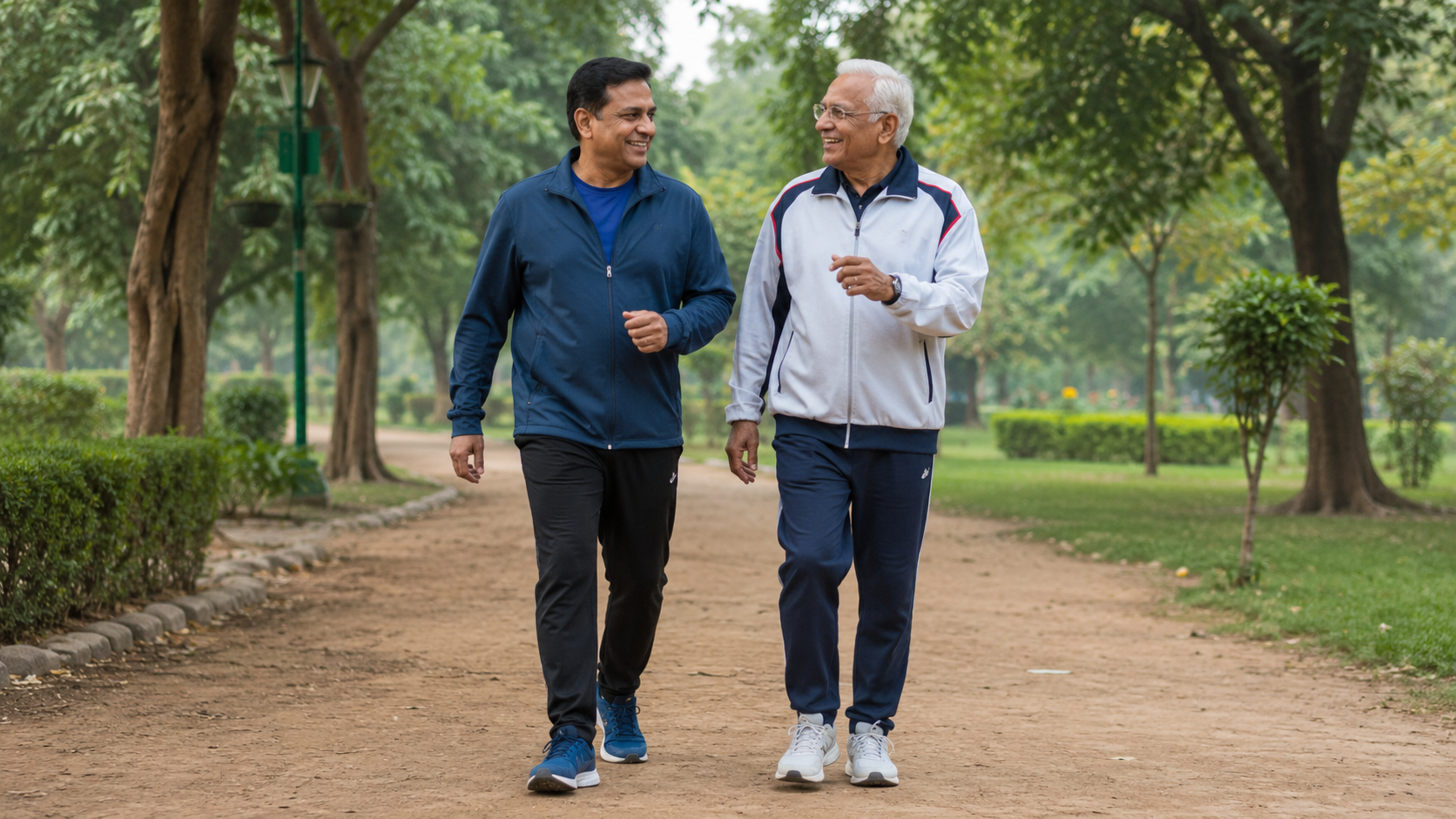
An older adult and a younger adult walking briskly together in a park, illustrating active knee care at every age.

Overview

Knees are built to last a lifetime, but they respond to how they are used. The good news is that the factors most strongly linked to long-term knee problems — weak muscles, excess weight, sudden overload and poorly rehabilitated injuries — are largely within your control. Looking after your knees is less about avoiding activity and more about loading them well: enough to keep the joint and its cartilage nourished and the muscles strong, without sudden spikes the joint is not prepared for.

This guide is for people who want to protect healthy knees, and for those with early niggles who want to keep them from progressing. If you already have significant knee pain, see our knee pain and knee osteoarthritis pages for condition-specific advice.

Diagram of the knee highlighting the quadriceps, hamstring and hip muscles that protect the joint.

Symptoms & signs

This is a preventive guide rather than a condition, but a few early warning signs are worth acting on before they become established problems:

  • Aching in the knee after activities that never used to bother you.
  • Occasional swelling after long walks, stairs or sport.
  • Stiffness after sitting for a while that eases as you move.
  • A knee that feels weak or slightly unstable on uneven ground.
  • Clicking or grinding that is new, especially with any discomfort.

None of these is an emergency, but each is a cue to strengthen the knee, review your activity and, if it persists beyond a few weeks, get it assessed.

Causes & risk factors

Understanding what puts knees at risk explains why the advice below works. The main modifiable risk factors are:

  • Muscle weakness — weak quadriceps and hip muscles let load pass straight to the joint.
  • Excess body weight — the strongest modifiable factor; load multiplies across every step.
  • Sudden increases in activity — most overuse injuries follow a jump in distance, intensity or a new sport.
  • Poorly rehabilitated injuries — an ACL, meniscus or kneecap injury that never regained full strength and stability accelerates later wear.
  • Prolonged inactivity — under-loaded cartilage thins and muscles weaken.
  • Repetitive deep loading — constant deep squatting and kneeling, common in some jobs and daily routines.

Age, sex and genetics also play a part and cannot be changed — which is exactly why the modifiable factors deserve attention.

When to see a doctor

As a general guide, have a knee assessed rather than simply pushing on if:

  • Pain or swelling lasts more than two to three weeks despite sensible self-care.
  • The knee gives way, locks or catches.
  • Pain follows a specific injury with rapid swelling or a pop.
  • Discomfort is steadily worsening or waking you at night.
  • A knee that was previously injured is becoming gradually more painful.

And seek prompt care for any red flags — a hot, red, swollen knee with fever, inability to bear weight, or a deformed joint after injury.

How it's diagnosed

You do not need a diagnosis to protect healthy knees. But if you are starting exercise with existing niggles, a quick assessment can make it safer and more effective. At VinayakM this means a brief history (past injuries, current activity, what aggravates the knee), a examination of muscle strength, alignment and stability, and — only if something specific is suspected — imaging. Most people leave with a tailored strengthening plan rather than a scan.

Treatment options

The 'treatment' for knee-health maintenance is a set of habits, each backed by evidence:

1. Strengthen the muscles around the knee.

  • Target the quadriceps, hamstrings and hip muscles. Simple home options: sit-to-stand from a chair, step-ups, straight-leg raises, wall sits and glute bridges.
  • Aim for strength work twice a week. Progress gradually by adding repetitions, then resistance.

2. Keep a healthy body weight.

  • Because load multiplies across the knee, even a modest reduction in excess weight meaningfully lowers the strain. Our dietician can help where useful.

3. Stay active with a mix of activities.

  • Combine low-impact aerobic work (walking, cycling, swimming) with strength work. Regular movement nourishes cartilage.
  • Vary your loading rather than repeating identical heavy activity every day.

4. Increase new activity gradually.

  • Follow a roughly 10%-per-week guide when building running distance or a new sport, and include a proper warm-up. Most overuse injuries are avoidable this way.

5. Look after injuries properly.

  • Rehabilitate a sprain, meniscus or ligament injury fully — regaining strength and stability — rather than returning as soon as the pain eases.

6. Sensible footwear and surfaces.

  • Cushioned, supportive shoes; be cautious with sudden heavy training on hard surfaces.

These cost nothing and outperform any supplement.

How VinayakM helps

At VinayakM in Greater Kailash-1, Dr Udit Vinayak (trauma, sports medicine and joint replacement surgeon) sees the full arc of knee problems — which makes prevention advice concrete rather than generic. We offer:

  • A knee MOT: assessment of strength, alignment and old injuries, with a personalised strengthening programme you can do at home or with a physiotherapist.
  • Weight-management support via our dietician where it will genuinely reduce knee load.
  • Guidance on returning to sport or exercise safely after a niggle or injury.
  • Honest advice on what helps and what to skip — so you invest effort where it counts.

The aim is simple: keep your own knees serving you well for as long as possible.
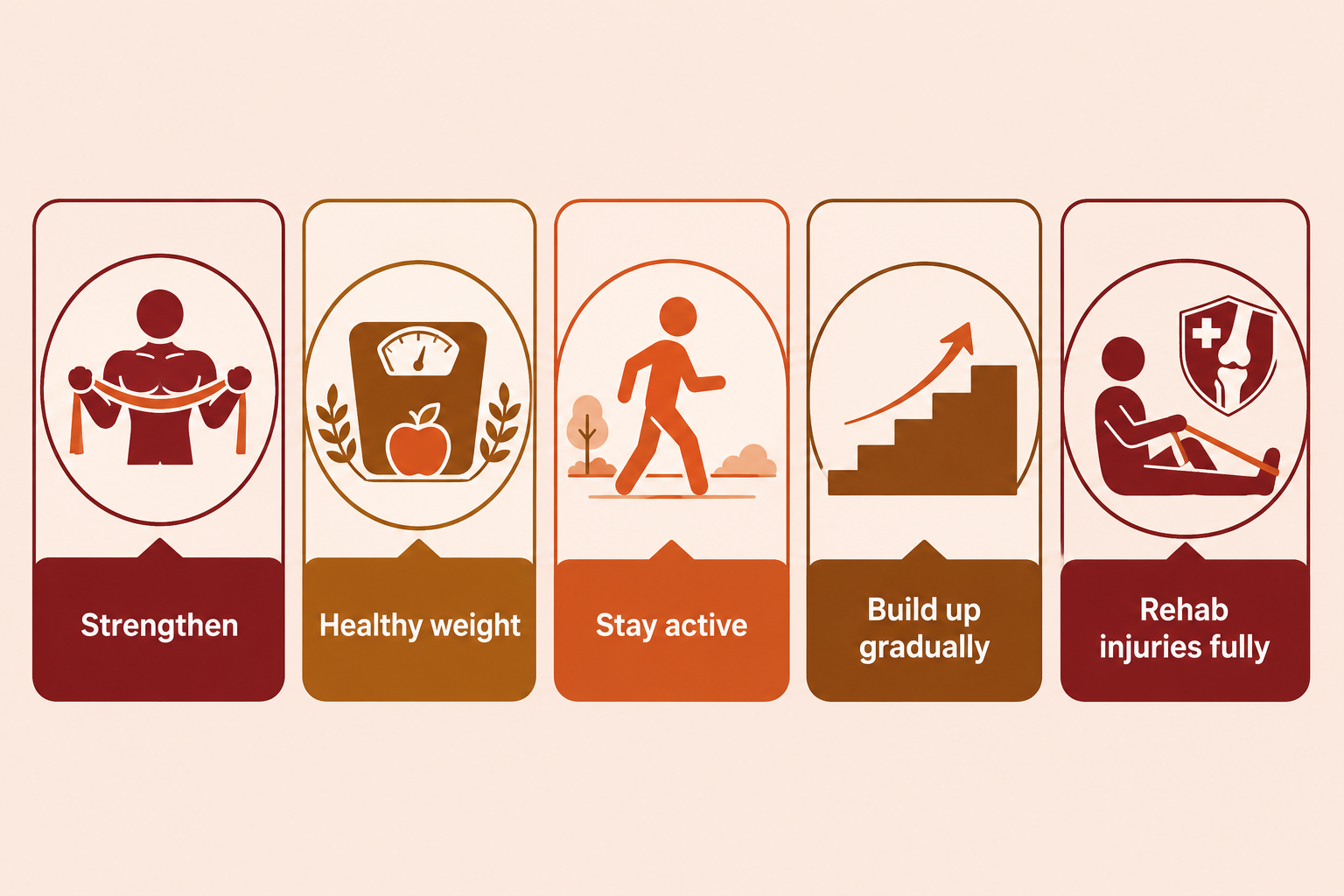
The pillars of knee health: strengthen, maintain a healthy weight, stay active, build up gradually and rehabilitate injuries fully.

Prevention & self-care

If you remember only a handful of things, make them these:
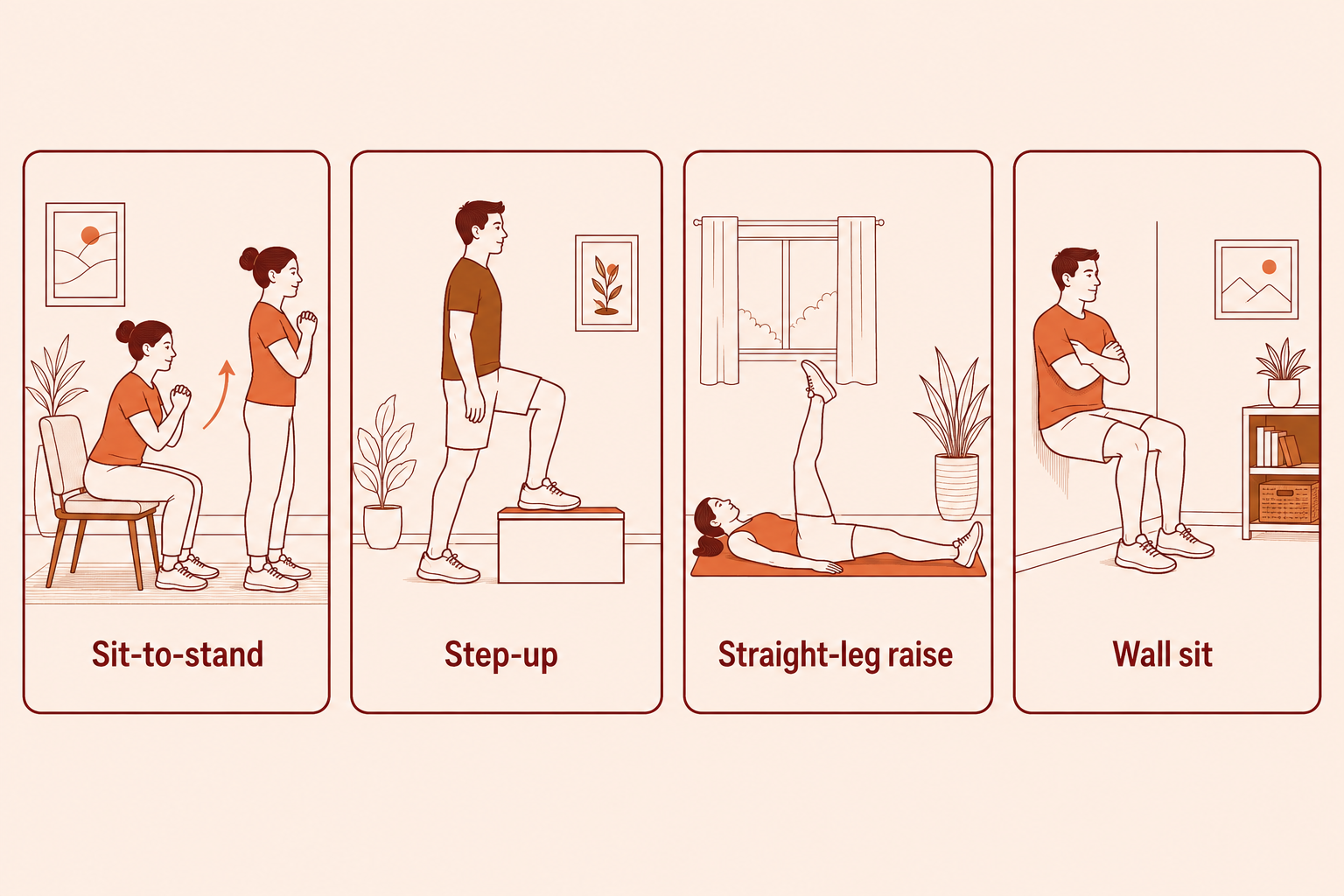
  • Strong thighs protect knees — do strength work twice a week; sit-to-stand and step-ups are enough to start.
  • Every kilogram counts — a healthy weight is the biggest single favour you can do your knees.
  • Move most days, mixing low-impact cardio with strength; cartilage needs movement to stay healthy.
  • Build up slowly — spikes in distance or intensity cause most injuries.
  • Finish your rehab — a half-rehabilitated knee is a future problem.
  • Act early — niggles that last beyond a few weeks are easier to fix than long-standing ones.
  • Skip the miracle cures — no pill, brace or gadget replaces strength, weight control and sensible loading.
Illustration of four home knee-strengthening exercises: sit-to-stand, step-ups, straight-leg raise and wall sit.

Frequently asked questions

What is the single best exercise for knee health?

If you had to pick one, the sit-to-stand (standing up from a chair and sitting back down under control) is hard to beat — it strengthens the quadriceps and hips together in a movement you use all day. Build up repetitions gradually, and progress to step-ups and other strength work for the best protection.

Does climbing stairs damage the knees?

For healthy knees, using stairs is good exercise and helps keep the leg muscles strong. Stairs do load the kneecap heavily, so if you have front-of-knee pain, build up gradually and strengthen the thigh and hip muscles. Avoiding stairs entirely tends to weaken the very muscles that protect the knee.

Should I wear a knee support to protect my knees?

For everyday healthy knees, a support is not needed and can encourage reliance rather than strength. Braces have specific roles — after certain injuries or for particular instabilities — best advised by a clinician. For general knee health, strengthening the muscles is far more valuable than a sleeve.

Are supplements like glucosamine worth taking for knee health?

The evidence that glucosamine, chondroitin or collagen protect or rebuild knees is weak, and major guidelines do not recommend them. The money and effort are better spent on strengthening, staying active and maintaining a healthy weight, which have strong evidence behind them.

Is squatting bad for the knees?

Controlled squatting within a comfortable range is a useful strengthening exercise for most people. Problems come from very deep, heavy or repetitive loaded squatting, or squatting through pain. If deep squatting flares your knee, reduce the depth and load rather than avoiding the movement altogether.

Related reading

References

  1. National Health Service (NHS). Knee pain — prevention and self-care. — https://www.nhs.uk/conditions/knee-pain/
  2. American Academy of Orthopaedic Surgeons — OrthoInfo. Knee conditioning program. — https://orthoinfo.aaos.org/en/recovery/knee-conditioning-program/
  3. World Health Organization. Physical activity fact sheet. — https://www.who.int/news-room/fact-sheets/detail/physical-activity
  4. Fransen M, et al. Exercise for osteoarthritis of the knee. Cochrane Database of Systematic Reviews. 2015;(1):CD004376. — https://doi.org/10.1002/14651858.CD004376.pub3
This page is for general information and education only. It is not a substitute for a consultation, diagnosis or treatment from a qualified clinician. If you have any of the red-flag symptoms above, seek medical care promptly.
{"@context":"https://schema.org","@graph":[{"@type":["MedicalClinic","LocalBusiness"],"@id":"https://www.vinayakm.in/#clinic","name":"VinayakM","url":"https://www.vinayakm.in","logo":"https://cdn.prod.website-files.com/6908cd2bb6a88638d8c0e611/6a494a210e7a3f8e0c33192a_vinayakm-name-logo.png","telephone":"+91 92171 75397","email":"info@vinayakm.in","address":{"@type":"PostalAddress","streetAddress":"3rd floor, B-23, Block B, N Block Market","addressLocality":"Greater Kailash-1, New Delhi","addressRegion":"Delhi","postalCode":"110048","addressCountry":"IN"},"geo":{"@type":"GeoCoordinates","latitude":28.556354,"longitude":77.2323718},"openingHours":["Mo-Tu 09:00-20:00","Th-Su 09:00-20:00"],"founder":{"@type":"Person","name":"Mani Sharma"},"sameAs":["https://maps.app.goo.gl/jPVPXKfH8qAUUDeo8"]},{"@type":"MedicalWebPage","@id":"https://www.vinayakm.in/orthopaedics/maintain-knee-health#webpage","url":"https://www.vinayakm.in/orthopaedics/maintain-knee-health","name":"How to Keep Your Knees Healthy | VinayakM","description":"Practical, evidence-based ways to protect your knees: strengthening, healthy weight, safe activity and early attention to injuries. Guidance from a GK-1 orthopaedic surgeon.","inLanguage":"en-IN","about":{"@type":"MedicalCondition","name":"Knee health maintenance","alternateName":["Knee care","Protecting your knees"]},"author":{"@type":"Physician","name":"Dr Udit Vinayak","jobTitle":"Trauma, Sports Medicine & Joint Replacement Surgeon","url":"https://www.vinayakm.in/team/dr-udit-vinayak","medicalSpecialty":"Orthopedic"},"reviewedBy":{"@type":"Physician","name":"Dr Udit Vinayak","jobTitle":"Trauma, Sports Medicine & Joint Replacement Surgeon","url":"https://www.vinayakm.in/team/dr-udit-vinayak","medicalSpecialty":"Orthopedic"},"lastReviewed":"2026-07-05","dateModified":"2026-07-05","publisher":{"@id":"https://www.vinayakm.in/#clinic"},"medicalAudience":{"@type":"MedicalAudience","audienceType":"Patient"}},{"@type":"FAQPage","@id":"https://www.vinayakm.in/orthopaedics/maintain-knee-health#faq","mainEntity":[{"@type":"Question","name":"What is the single best exercise for knee health?","acceptedAnswer":{"@type":"Answer","text":"If you had to pick one, the sit-to-stand (standing up from a chair and sitting back down under control) is hard to beat — it strengthens the quadriceps and hips together in a movement you use all day. Build up repetitions gradually, and progress to step-ups and other strength work for the best protection."}},{"@type":"Question","name":"Does climbing stairs damage the knees?","acceptedAnswer":{"@type":"Answer","text":"For healthy knees, using stairs is good exercise and helps keep the leg muscles strong. Stairs do load the kneecap heavily, so if you have front-of-knee pain, build up gradually and strengthen the thigh and hip muscles. Avoiding stairs entirely tends to weaken the very muscles that protect the knee."}},{"@type":"Question","name":"Should I wear a knee support to protect my knees?","acceptedAnswer":{"@type":"Answer","text":"For everyday healthy knees, a support is not needed and can encourage reliance rather than strength. Braces have specific roles — after certain injuries or for particular instabilities — best advised by a clinician. For general knee health, strengthening the muscles is far more valuable than a sleeve."}},{"@type":"Question","name":"Are supplements like glucosamine worth taking for knee health?","acceptedAnswer":{"@type":"Answer","text":"The evidence that glucosamine, chondroitin or collagen protect or rebuild knees is weak, and major guidelines do not recommend them. The money and effort are better spent on strengthening, staying active and maintaining a healthy weight, which have strong evidence behind them."}},{"@type":"Question","name":"Is squatting bad for the knees?","acceptedAnswer":{"@type":"Answer","text":"Controlled squatting within a comfortable range is a useful strengthening exercise for most people. Problems come from very deep, heavy or repetitive loaded squatting, or squatting through pain. If deep squatting flares your knee, reduce the depth and load rather than avoiding the movement altogether."}}]},{"@type":"BreadcrumbList","@id":"https://www.vinayakm.in/orthopaedics/maintain-knee-health#breadcrumbs","itemListElement":[{"@type":"ListItem","position":1,"name":"Home","item":"https://www.vinayakm.in"},{"@type":"ListItem","position":2,"name":"Orthopaedics","item":"https://www.vinayakm.in/orthopaedics"},{"@type":"ListItem","position":3,"name":"How to Keep Your Knees Healthy: A Practical Guide","item":"https://www.vinayakm.in/orthopaedics/maintain-knee-health"}]}]}
WhatsApp