Knee Pain: Causes, Treatment & When to See a Specialist

Quick answer
Knee pain is most often caused by strain or overuse, wear-related arthritis, injuries to the ligaments or meniscus, or problems around the kneecap. Most knee pain settles with relative rest, simple pain relief and exercises to strengthen the muscles around the knee, but pain that follows a significant injury, comes with a hot swollen joint, or keeps limiting your daily activities should be assessed by a doctor. At VinayakM in Greater Kailash-1, an orthopaedic surgeon examines the knee, arranges imaging only where it changes the plan, and starts with the least invasive treatment that fits your problem.
Last reviewed:
July 5, 2026
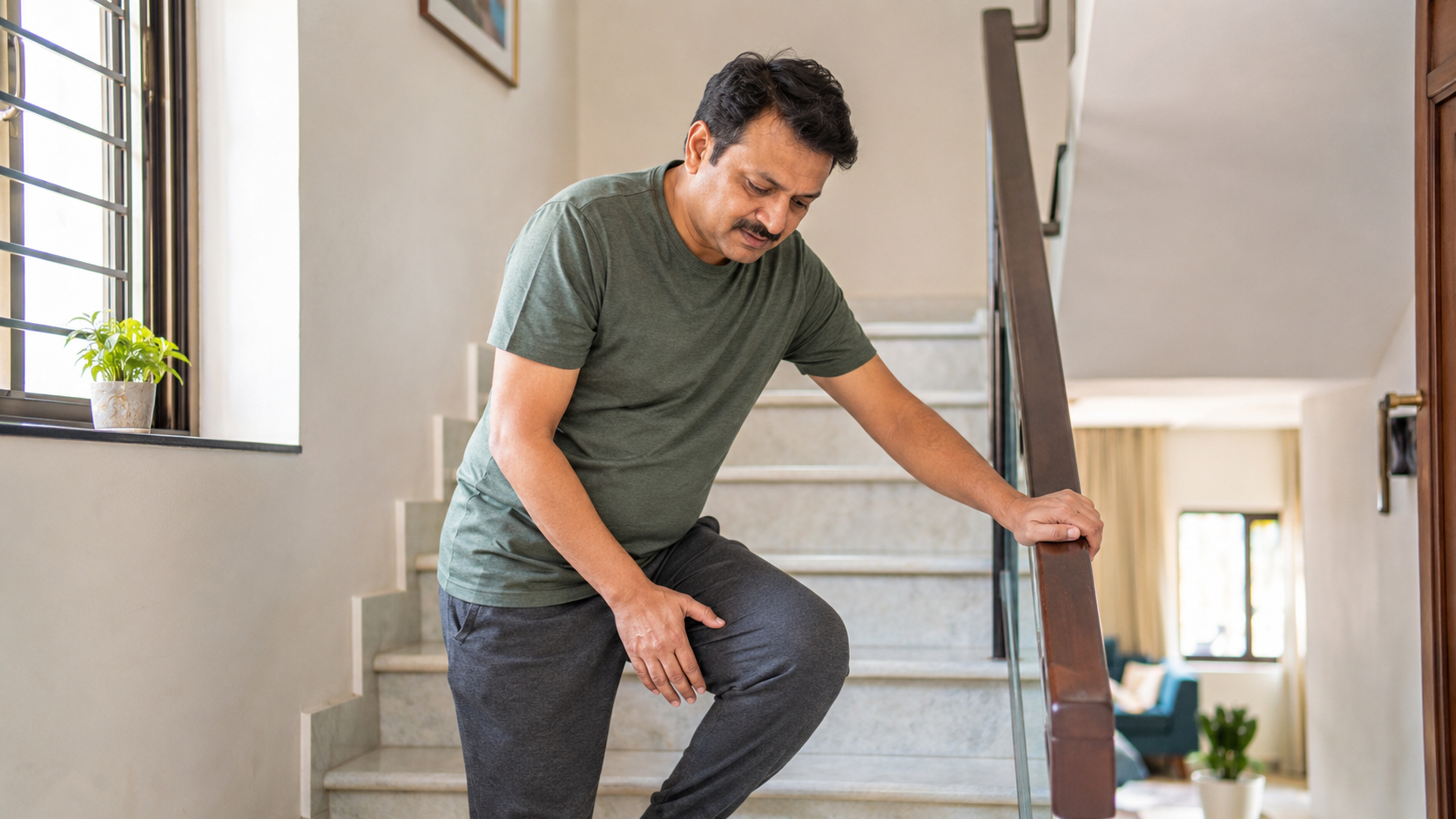
An active adult pausing on a staircase and holding their knee, illustrating everyday knee pain.

Overview

The knee is the largest joint in the body and carries your full body weight with every step, which is why it is one of the most common sites of pain at every age. Pain can arise from several structures: the joint surfaces and cartilage, the ligaments that stabilise the knee, the two menisci (shock-absorbing cartilage pads), the kneecap (patella) and its groove, the tendons above and below the kneecap, or the small fluid-filled sacs (bursae) around the joint.

The pattern of your pain — where it hurts, when it started, what brings it on — usually points to the cause. Pain that builds gradually with age and activity suggests wear-related change; pain after a twist or fall suggests an injury; pain at the front of the knee on stairs and slopes often comes from the kneecap; and pain with marked swelling and heat needs prompt attention.
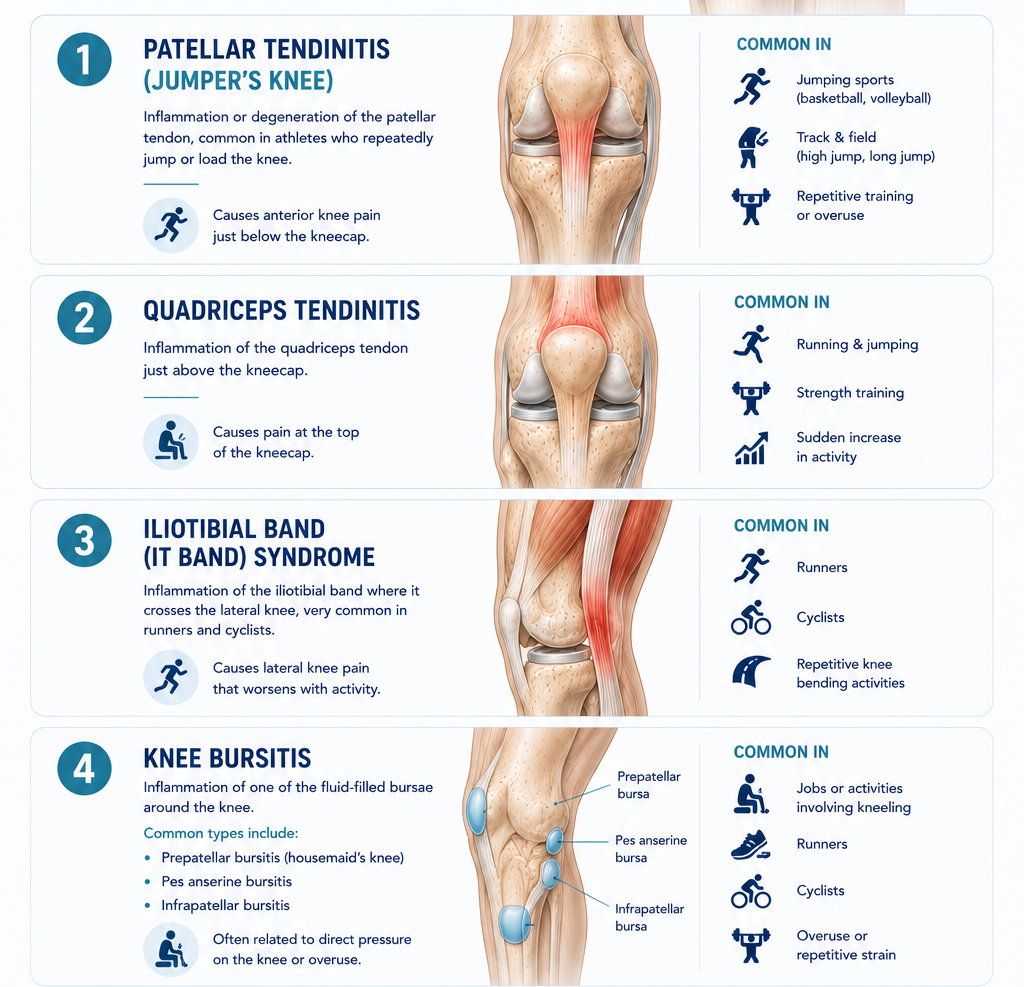
Labelled diagram of the knee joint showing the femur, tibia, patella, ligaments, menisci and common sources of knee pain.

Symptoms & signs

Knee pain rarely comes alone. Depending on the cause, you may also notice:

  • Swelling — immediate swelling after an injury suggests bleeding inside the joint; slower swelling over hours to days is more typical of a meniscus injury or arthritis flare.
  • Stiffness, especially in the morning or after sitting.
  • Clicking, grinding or catching sensations.
  • Locking — the knee gets stuck and will not fully straighten (often a meniscus tear fragment).
  • Giving way — a feeling of instability, common after ligament injuries.
  • Pain in a particular position — at the front on stairs (kneecap), on the inner side in middle age (early arthritis or meniscus), behind the knee (Baker's cyst or hamstring strain).

Noting these patterns before your consultation genuinely speeds up diagnosis.

Causes & risk factors

Common causes differ by age and situation:

  • Overuse and strain — a sudden increase in walking, running, stairs or squatting can inflame tendons and soft tissues at any age.
  • Knee osteoarthritis — gradual cartilage wear, usually from the 50s onward; the most common cause of chronic knee pain in India. Read more on our knee osteoarthritis page.
  • Meniscus tears — from a twist on a bent knee in younger people, or with minimal injury in older knees as the meniscus becomes brittle.
  • Ligament injuries — the ACL and MCL are typically injured during sports, a slip, or a road accident; the knee often swells quickly and feels unstable.
  • Kneecap (patellofemoral) pain — pain at the front of the knee, worse on stairs, slopes and prolonged sitting; common in younger and active people.
  • Tendon problems — patellar or quadriceps tendinopathy in people who jump, run or climb frequently.
  • Bursitis — inflammation of the small cushioning sacs, classically after prolonged kneeling.
  • Referred pain — hip or spine problems can present as knee pain, particularly in children and older adults.
  • Inflammatory arthritis, gout or infection — the knee becomes hot, red and swollen, sometimes with fever; these need urgent assessment.

When to see a doctor

See a doctor promptly if your knee pain comes with any of these red flags:

  • A hot, red, swollen knee, especially with fever or feeling unwell — possible joint infection, which is an emergency.
  • You cannot put weight on the leg, or the knee looks deformed after an injury.
  • The knee swelled up within an hour of an injury, or you heard a pop followed by instability.
  • The knee is locked and will not fully straighten.
  • Pain that is severe at rest or at night, or is steadily worsening.
  • Numbness, tingling or coldness in the lower leg or foot.
  • Unexplained weight loss or a general feeling of illness alongside the pain.

Without red flags, it is still sensible to be assessed if pain has lasted more than two to three weeks despite rest and simple measures, or if it keeps returning.

How it's diagnosed

At VinayakM in Greater Kailash-1, assessment of knee pain is clinical first:

  1. History — when and how the pain started, any injury, the exact location, what worsens and relieves it, and how it limits your day.
  2. Examination — swelling, warmth, tenderness, range of movement, ligament stability tests, meniscus tests, kneecap tracking, and your gait.
  3. X-rays where arthritis, alignment problems or a fracture are suspected — done standing where possible, because weight-bearing films show the joint space realistically.
  4. MRI only when a soft-tissue injury (ligament or meniscus) is suspected and the result would change management — not as a routine test for every painful knee.
  5. Blood tests or joint fluid analysis if gout, inflammatory arthritis or infection is a possibility.

The aim is a specific working diagnosis — "knee pain" is a symptom, not an answer.

Treatment options

Treatment depends on the cause, but for most non-emergency knee pain it follows a stepped approach:

1. First measures (most people, most causes):

  • Relative rest — reduce the aggravating activity without stopping movement altogether; complete rest weakens the muscles that protect the knee.
  • Ice and elevation for flare-ups and after injury.
  • Simple pain relief — topical anti-inflammatory gels first; short courses of oral painkillers on medical advice.
  • Exercise therapy and physiotherapy — strengthening the quadriceps, hamstrings and hip muscles is the single most consistently effective treatment for most chronic knee pain.
  • Weight management where relevant, to reduce load on the joint.

2. Cause-specific treatment:

  • Kneecap pain responds well to targeted physiotherapy and activity modification.
  • Meniscus tears in older knees are usually treated without surgery first; locked knees or persistent mechanical symptoms may need arthroscopic (keyhole) surgery.
  • Complete ACL tears in active people may need reconstruction, decided case by case.
  • Arthritis follows its own pathway — see knee osteoarthritis.
  • Gout, inflammatory arthritis and infection are treated with the appropriate medication; infection needs urgent hospital care.

3. Injections and surgery are reserved for specific diagnoses where the evidence and your circumstances support them — they are not shortcuts past the basics.

How VinayakM helps

At VinayakM, knee pain is assessed by Dr Udit Vinayak, a trauma, sports medicine and joint replacement surgeon — which matters, because the full range of options from physiotherapy through keyhole surgery to replacement sits with one clinician, and you are guided to the right step rather than the most invasive one. In practice:

  • A focused examination and, only where useful, standing X-rays or MRI — you will not be sent for scans that do not change the plan.
  • A clear working diagnosis explained in plain language, with a written plan.
  • Exercise-first treatment with physiotherapy guidance; our dietician can support weight management where it will genuinely help the knee.
  • Injection options or surgery discussed honestly — including what the evidence supports — when the diagnosis warrants them.

Follow-up is arranged so the plan is adjusted based on how your knee actually responds.
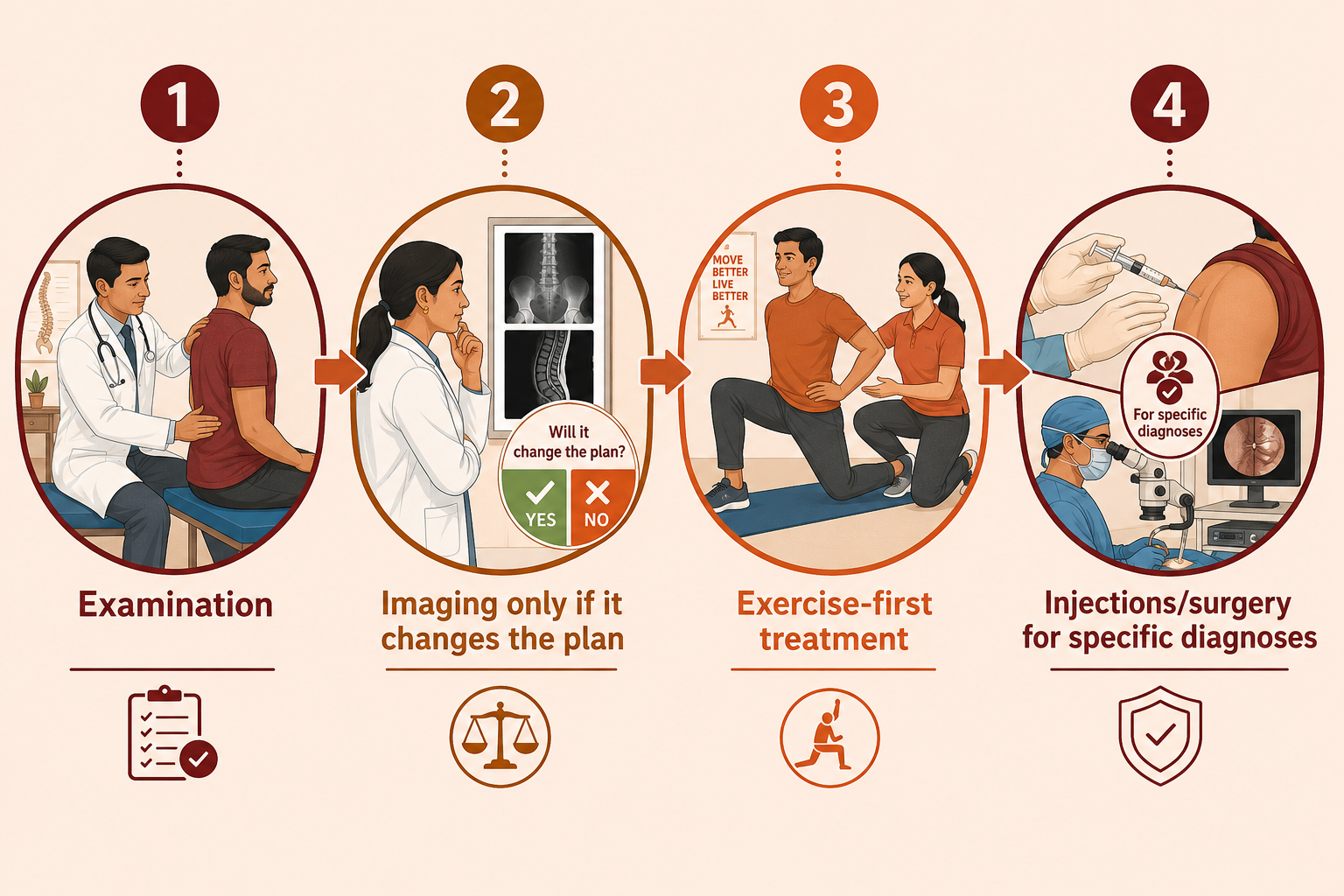
Assessment-to-treatment pathway for knee pain: examination, targeted imaging when needed, exercise-first treatment, then injections or surgery only for specific diagnoses.

Prevention & self-care

Most knee pain risk is reducible:

  • Keep the leg muscles strong. Strong quadriceps, hamstrings and hip muscles absorb load before the joint does. Sit-to-stand repetitions, step-ups and straight-leg raises are simple home options.
  • Build up activity gradually — most overuse pain follows a sudden jump in running distance, stairs or new sports.
  • Warm up before sport and include balance work; many ligament injuries occur early in play.
  • Maintain a healthy weight — every extra kilogram multiplies across thousands of daily steps.
  • Use sensible footwear with cushioning and support, especially on hard surfaces.
  • Break up prolonged kneeling and deep squatting if your work or routine involves them.

Start new exercises gently and stop anything causing sharp or lasting pain; if unsure, ask for a tailored programme.
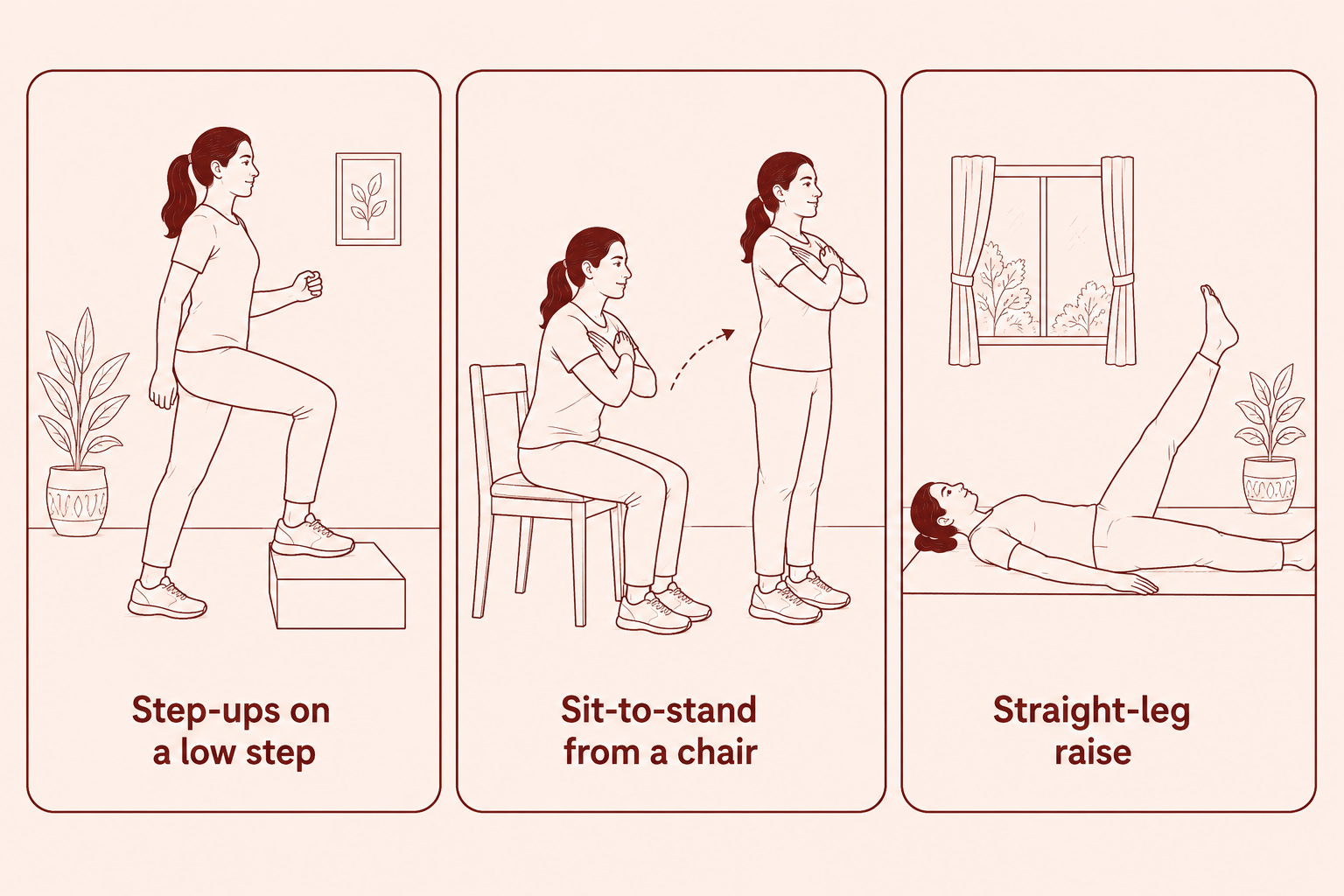
Illustration of three knee-strengthening exercises: step-ups, sit-to-stand and straight-leg raise.

Frequently asked questions

When should I worry about knee pain?

Seek prompt medical care if the knee is hot, red and swollen (especially with fever), if you cannot bear weight, if the knee is locked or looks deformed, if it swelled rapidly after an injury, or if pain is severe at rest or at night. Otherwise, knee pain that has not improved after two to three weeks of sensible self-care deserves an assessment.

Do I need an X-ray or MRI for knee pain?

Not always. The examination usually identifies the likely cause. X-rays help when arthritis, alignment problems or fracture are suspected, and MRI is reserved for suspected ligament or meniscus injuries where the result would change treatment. Scanning every painful knee adds cost and worry without improving care.

Why does my knee hurt when climbing stairs?

Pain at the front of the knee on stairs and slopes most often comes from the kneecap and its groove (patellofemoral pain) or from early cartilage wear behind the kneecap. Stairs load this area at several times body weight. Targeted strengthening of the thigh and hip muscles is usually the mainstay of treatment.

Is walking good for knee pain?

Usually yes. For most chronic knee pain, staying active maintains muscle strength and joint nutrition, while complete rest makes the knee weaker and stiffer. The exceptions are acute injuries with red flags, which need assessment first. If a particular distance consistently flares your pain, build up more gradually rather than stopping altogether.

Can knee pain come from somewhere else in the body?

Yes. Hip problems and, less commonly, spine problems can refer pain to the knee — this is well recognised in children and older adults. This is one reason a proper examination covers the hip and back as well as the knee itself.

What is the treatment for a meniscus (cartilage) tear?

It depends on the type of tear and your age. Many tears, particularly wear-related tears in older knees, settle with physiotherapy and do not need surgery. Keyhole surgery is considered when the knee locks, when mechanical symptoms persist despite rehabilitation, or for certain tears in younger patients. The decision is individual and should be discussed with a surgeon.

Related reading

References

  1. National Health Service (NHS). Knee pain. — https://www.nhs.uk/conditions/knee-pain/
  2. American Academy of Orthopaedic Surgeons — OrthoInfo. Common knee injuries. — https://orthoinfo.aaos.org/en/diseases--conditions/common-knee-injuries/
  3. National Institute for Health and Care Excellence (NICE). Osteoarthritis in over 16s: diagnosis and management. NICE guideline NG226. — https://www.nice.org.uk/guidance/ng226
  4. Fransen M, et al. Exercise for osteoarthritis of the knee. Cochrane Database of Systematic Reviews. 2015;(1):CD004376. — https://doi.org/10.1002/14651858.CD004376.pub3
This page is for general information and education only. It is not a substitute for a consultation, diagnosis or treatment from a qualified clinician. If you have any of the red-flag symptoms above, seek medical care promptly.
{"@context":"https://schema.org","@graph":[{"@type":["MedicalClinic","LocalBusiness"],"@id":"https://www.vinayakm.in/#clinic","name":"VinayakM","url":"https://www.vinayakm.in","logo":"https://cdn.prod.website-files.com/6908cd2bb6a88638d8c0e611/6a494a210e7a3f8e0c33192a_vinayakm-name-logo.png","telephone":"+91 92171 75397","email":"info@vinayakm.in","address":{"@type":"PostalAddress","streetAddress":"3rd floor, B-23, Block B, N Block Market","addressLocality":"Greater Kailash-1, New Delhi","addressRegion":"Delhi","postalCode":"110048","addressCountry":"IN"},"geo":{"@type":"GeoCoordinates","latitude":28.556354,"longitude":77.2323718},"openingHours":["Mo-Tu 09:00-20:00","Th-Su 09:00-20:00"],"founder":{"@type":"Person","name":"Mani Sharma"},"sameAs":["https://maps.app.goo.gl/jPVPXKfH8qAUUDeo8"]},{"@type":"MedicalWebPage","@id":"https://www.vinayakm.in/orthopaedics/knee-pain#webpage","url":"https://www.vinayakm.in/orthopaedics/knee-pain","name":"Knee Pain: Causes & When to See a Doctor | VinayakM","description":"Knee pain can come from the joint, ligaments, meniscus or kneecap. Learn common causes, red flags, and how it is assessed and treated in GK-1, South Delhi.","inLanguage":"en-IN","about":{"@type":"MedicalCondition","name":"Knee pain","alternateName":["Painful knee","Knee joint pain"]},"author":{"@type":"Physician","name":"Dr Udit Vinayak","jobTitle":"Trauma, Sports Medicine & Joint Replacement Surgeon","url":"https://www.vinayakm.in/team/dr-udit-vinayak","medicalSpecialty":"Orthopedic"},"reviewedBy":{"@type":"Physician","name":"Dr Udit Vinayak","jobTitle":"Trauma, Sports Medicine & Joint Replacement Surgeon","url":"https://www.vinayakm.in/team/dr-udit-vinayak","medicalSpecialty":"Orthopedic"},"lastReviewed":"2026-07-05","dateModified":"2026-07-05","publisher":{"@id":"https://www.vinayakm.in/#clinic"},"medicalAudience":{"@type":"MedicalAudience","audienceType":"Patient"}},{"@type":"FAQPage","@id":"https://www.vinayakm.in/orthopaedics/knee-pain#faq","mainEntity":[{"@type":"Question","name":"When should I worry about knee pain?","acceptedAnswer":{"@type":"Answer","text":"Seek prompt medical care if the knee is hot, red and swollen (especially with fever), if you cannot bear weight, if the knee is locked or looks deformed, if it swelled rapidly after an injury, or if pain is severe at rest or at night. Otherwise, knee pain that has not improved after two to three weeks of sensible self-care deserves an assessment."}},{"@type":"Question","name":"Do I need an X-ray or MRI for knee pain?","acceptedAnswer":{"@type":"Answer","text":"Not always. The examination usually identifies the likely cause. X-rays help when arthritis, alignment problems or fracture are suspected, and MRI is reserved for suspected ligament or meniscus injuries where the result would change treatment. Scanning every painful knee adds cost and worry without improving care."}},{"@type":"Question","name":"Why does my knee hurt when climbing stairs?","acceptedAnswer":{"@type":"Answer","text":"Pain at the front of the knee on stairs and slopes most often comes from the kneecap and its groove (patellofemoral pain) or from early cartilage wear behind the kneecap. Stairs load this area at several times body weight. Targeted strengthening of the thigh and hip muscles is usually the mainstay of treatment."}},{"@type":"Question","name":"Is walking good for knee pain?","acceptedAnswer":{"@type":"Answer","text":"Usually yes. For most chronic knee pain, staying active maintains muscle strength and joint nutrition, while complete rest makes the knee weaker and stiffer. The exceptions are acute injuries with red flags, which need assessment first. If a particular distance consistently flares your pain, build up more gradually rather than stopping altogether."}},{"@type":"Question","name":"Can knee pain come from somewhere else in the body?","acceptedAnswer":{"@type":"Answer","text":"Yes. Hip problems and, less commonly, spine problems can refer pain to the knee — this is well recognised in children and older adults. This is one reason a proper examination covers the hip and back as well as the knee itself."}},{"@type":"Question","name":"What is the treatment for a meniscus (cartilage) tear?","acceptedAnswer":{"@type":"Answer","text":"It depends on the type of tear and your age. Many tears, particularly wear-related tears in older knees, settle with physiotherapy and do not need surgery. Keyhole surgery is considered when the knee locks, when mechanical symptoms persist despite rehabilitation, or for certain tears in younger patients. The decision is individual and should be discussed with a surgeon."}}]},{"@type":"BreadcrumbList","@id":"https://www.vinayakm.in/orthopaedics/knee-pain#breadcrumbs","itemListElement":[{"@type":"ListItem","position":1,"name":"Home","item":"https://www.vinayakm.in"},{"@type":"ListItem","position":2,"name":"Orthopaedics","item":"https://www.vinayakm.in/orthopaedics"},{"@type":"ListItem","position":3,"name":"Knee Pain: Causes, Treatment & When to See a Specialist","item":"https://www.vinayakm.in/orthopaedics/knee-pain"}]}]}
WhatsApp